


Physical Copper vs Tokenised Copper: What Investors Should Understand in 2026
Copper Cathodes, Blockchain Tokens, and the Difference Between Metal Ownership and Digital Claims
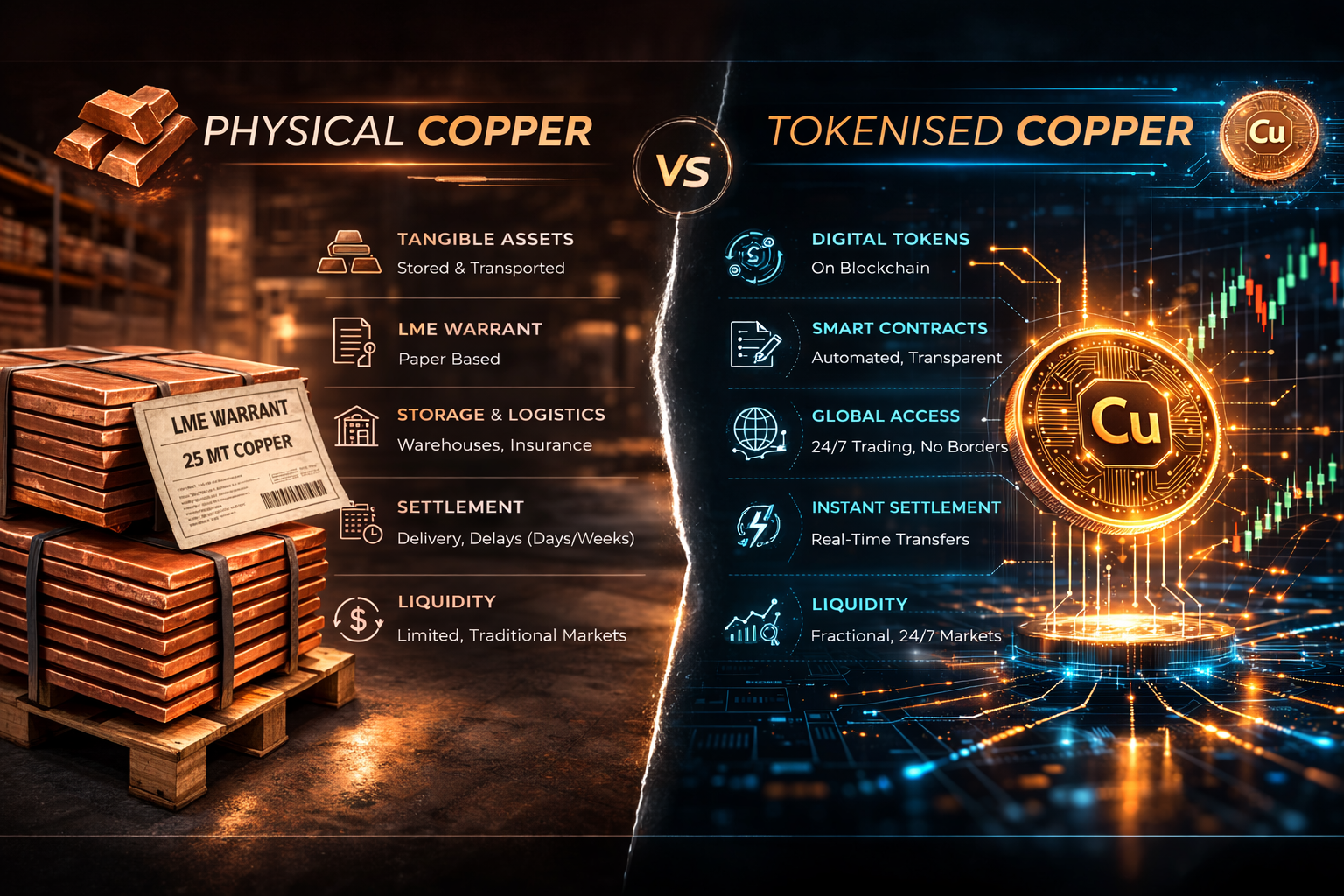
Physical Copper vs Tokenised Copper: What Investors Should Understand in 2026
Copper cathodes, blockchain tokens, and the difference between metal ownership and digital claims.
Two Products. One Name. Very Different Structures.
Both are called "copper exposure." Only one gives you actual copper. In 2026, the difference between owning physical copper and holding a tokenised copper product is not a technicality: it is the difference between a claim on a digital ledger and title to an industrial asset that the global economy cannot function without.
Tokenised copper products are gaining attention as blockchain platforms expand into commodity markets. Physical copper ownership, meanwhile, has been the institutional standard for decades. Before choosing a route, you need to understand what each structure actually gives you, and where each one sits in the global copper market hierarchy.
What Is Tokenised Copper?
Tokenised copper refers to digital tokens issued on blockchain platforms that claim to represent a quantity of copper, exposure to copper prices, or ownership in a pool of copper-related assets. These products can involve custodial storage arrangements, third-party verification, redemption conditions, and smart contract issuance. The investor holds a digital token rather than copper directly.
The structure varies significantly between providers. Some tokens represent a fractional claim on stored metal held by a custodian. Others track copper prices without any physical backing. The key point: what you hold is a digital instrument whose value depends on the integrity of the issuer, the custodian, the smart contract, and the platform. The metal itself may or may not be there, and your ability to access it depends on conditions set by others.
A digital token issued on a blockchain that represents a claim relating to copper. The claim may be a fractional share of stored metal, price exposure, or a pool of copper-related assets. The investor holds a digital instrument, not the metal itself. The value and redeemability of the token depend on the issuer, custodian, and platform.
What Is Physical Copper Ownership?
Physical copper ownership means holding title to refined copper cathodes at 99.99% purity, stored in professional warehouses and eligible for London Metal Exchange (LME) warrant registration. Copper cathodes are the benchmark traded form of copper globally: the format major institutions buy, sell, and settle in.
A full LME copper warrant represents 25 metric tonnes of deliverable copper: the institutional clearing unit where global copper pricing converges. When your copper is stored in LME-approved facilities and registered as a warrant, it sits inside the same system that JPMorgan Chase, Goldman Sachs, and Glencore use to transact. It is not a claim on copper. It is copper.
"The institutional copper market clears in cathodes and warrants. Tokenisation is a financial wrapper. The metal itself is the foundation."
— C4CU leadership
Core Structural Differences: Physical vs Tokenised
The table below maps the key structural differences. These are not matters of preference: they are factual differences in how each structure works, where risk sits, and what you actually own.
| Factor | Physical Copper | Tokenised Copper |
|---|---|---|
| What you own | Allocated metal in your name | A digital token representing a claim |
| Counterparty risk | Low: metal exists independently of any platform | Higher: depends on issuer, custodian, smart contract |
| Institutional alignment | Yes: same format used by major banks and traders | No: institutions transact in cathodes, not tokens |
| Redemption / liquidity | Tied to LME standards and recognised warehouse systems | Varies widely by platform and contract terms |
| Market layer | The foundational commodity market where pricing converges | A financial instrument built on top of commodity markets |
| Infrastructure dependency | Physical warehouse, insurance, title documentation | Blockchain platform, smart contracts, issuer solvency |
Counterparty Risk: Where Things Can Go Wrong
Tokenised copper introduces a chain of dependencies that physical ownership does not. Your token's value relies on the issuer remaining solvent, the custodian actually holding the stated copper, the smart contract executing correctly, and the platform remaining operational. If any link in that chain fails, your ability to recover value becomes a legal and logistical problem, not just a market risk.
Physical copper stored in recognised warehouse systems operates within established commodity market frameworks that predate blockchain by decades. The clearing mechanisms, title documentation, and delivery processes for LME-grade cathodes are mature, standardised, and institutionally battle-tested. The metal does not disappear if a platform goes offline.
With physical copper held in an LME-approved warehouse, the metal exists independently of any platform. With a tokenised product, your claim depends on the continued operation and integrity of the issuer, custodian, and blockchain infrastructure. These are meaningfully different risk profiles.
Why This Matters More in 2026
Copper demand is accelerating because of structural forces that are not going away. Electric vehicles use roughly four times more copper than conventional cars (International Copper Association). AI data centres require enormous copper wiring runs. Renewable energy infrastructure is copper-intensive by design. According to the International Energy Agency (IEA), electrification trends are expected to significantly increase copper demand over coming decades, while new mine supply remains constrained by long development timelines averaging 16 years from discovery to production (S&P Global, 2023).
If the thesis for owning copper centres on rising demand from structural industrial expansion, then the question of which layer you participate in becomes important. The global copper market clears in tonnes of physical cathodes. That is where supply and demand ultimately meet. A tokenised product may track that dynamic, but it does so from outside the physical market layer, with additional structural dependencies stacked on top.
Institutional copper buyers: JPMorgan Chase, Goldman Sachs, Glencore and others, transact in copper cathodes, warehouse warrants, and structured offtake contracts. Not blockchain tokens. The physical copper market is the foundational layer. Everything else is built on top of it.
When Tokenised Copper May Appeal
Tokenised copper is not without a use case. It may appeal to people who prioritise blockchain-native assets, want digital portability, prefer on-chain trading, or are already operating within crypto ecosystem infrastructure. For those whose primary activity is in digital asset markets, a tokenised copper product provides commodity exposure without leaving that ecosystem.
But it is a different asset class, not just a different format. It represents a digital financial instrument rather than the industrial commodity itself. Understanding that distinction is not a reason to avoid tokenised products outright: it is a reason to be precise about what you are actually holding and why.
The Physical Layer: How C4CU Fits
C4CU provides access to allocated physical copper aligned with institutional market standards: LME Grade A copper cathodes at 99.99% purity, stored in professional warehouses, with allocated ownership in your name from the point of purchase. There are no paper promises and no blockchain dependencies.
The minimum entry at C4CU is 10 kg, well below the institutional 25 MT LME warrant lot. That threshold exists so retail buyers can participate in the same physical copper market that institutions use, without needing institutional-scale capital. One all-inclusive 5% service fee covers storage, insurance, and management. Nothing else.
C4CU operates within the physical copper layer where global pricing ultimately converges. If you want copper exposure that aligns directly with the industrial market rather than a financial instrument built on top of it, physical ownership is the more direct route.
Frequently Asked Questions
Q: What is tokenised copper and how does it differ from physical copper?
Tokenised copper is a digital token issued on a blockchain that represents a claim relating to copper: either a fractional share of stored metal, price exposure, or a pool of copper-related assets. Physical copper ownership means holding allocated title to refined copper cathodes (99.99% purity) stored in a professional warehouse. The core difference is that physical ownership gives you the industrial asset directly; a token gives you a claim whose value depends on the issuer, custodian, and platform remaining operational.
Q: Is tokenised copper backed by real metal?
It depends entirely on the product. Some tokenised copper platforms do hold physical copper with a custodian and issue tokens against it. Others track copper prices without physical backing. Even where metal is held, the investor's ability to redeem it depends on the contract terms, minimum withdrawal quantities, and the issuer's continued operation. Unlike allocated physical ownership, the metal is held by a third party and the investor holds a digital claim, not a direct title to the metal itself.
Q: What are the risks of tokenised copper compared to physical copper?
Tokenised copper adds counterparty and platform risk that physical copper does not carry. The token's value depends on the issuer's solvency, the custodian actually holding the stated metal, the smart contract executing correctly, and the platform staying operational. Physical copper stored in an LME-approved warehouse exists independently of any platform. Both carry commodity price risk: the price of copper is volatile and can go down as well as up. But physical copper does not carry the additional layer of digital infrastructure dependency.
Q: Do major institutions use tokenised copper or physical copper?
Major financial institutions and commodity trading houses, including JPMorgan Chase, Goldman Sachs, and Glencore, transact in physical copper cathodes, LME warehouse warrants, and structured offtake contracts. The London Metal Exchange (LME) clears copper in deliverable physical lots of 25 metric tonnes. Institutional copper pricing and settlement converge on the physical market, not on blockchain tokens. Tokenised copper products remain outside the core institutional copper market infrastructure.
Q: Why is copper demand rising in 2026 and which exposure reflects that thesis most directly?
Copper demand is accelerating because of electrification: electric vehicles use approximately four times more copper than conventional cars (International Copper Association), AI data centres require significant copper wiring, and renewable energy systems are copper-intensive. The IEA projects significant demand growth over coming decades. Because the global copper market clears in physical cathodes (not digital instruments), physical copper ownership aligns most directly with the supply-demand dynamic driving the thesis. S&P Global (2023) estimates new mine supply faces average development timelines of 16 years, reinforcing the structural supply constraint.
Q: How do I own physical copper without storing it myself?
Physical copper can be held in professionally managed, insured warehouses aligned with LME standards without the buyer taking personal delivery. C4CU facilitates allocated ownership of LME Grade A copper cathodes from as little as 10 kg, with storage, insurance, and management covered by a single 5% all-inclusive service fee. Ownership is allocated in the buyer's name from the point of purchase. This provides direct participation in the physical copper market layer without requiring institutional-scale capital or personal storage infrastructure.
Ready to Own Physical Copper?
Start with as little as 10 kg of LME Grade A copper cathode: stored, insured, and allocated in your name.
Start Owning Copper →
Get Copper Market Updates
Join investors receiving insights on copper prices, market trends, and opportunities. Free, no spam.
By subscribing, you agree to our Privacy Policy.
Ready to Own Real Copper?
Start owning physical copper today. Simple, transparent, accessible.