


How to Invest in Copper: Physical Copper vs ETFs vs Mining Stocks
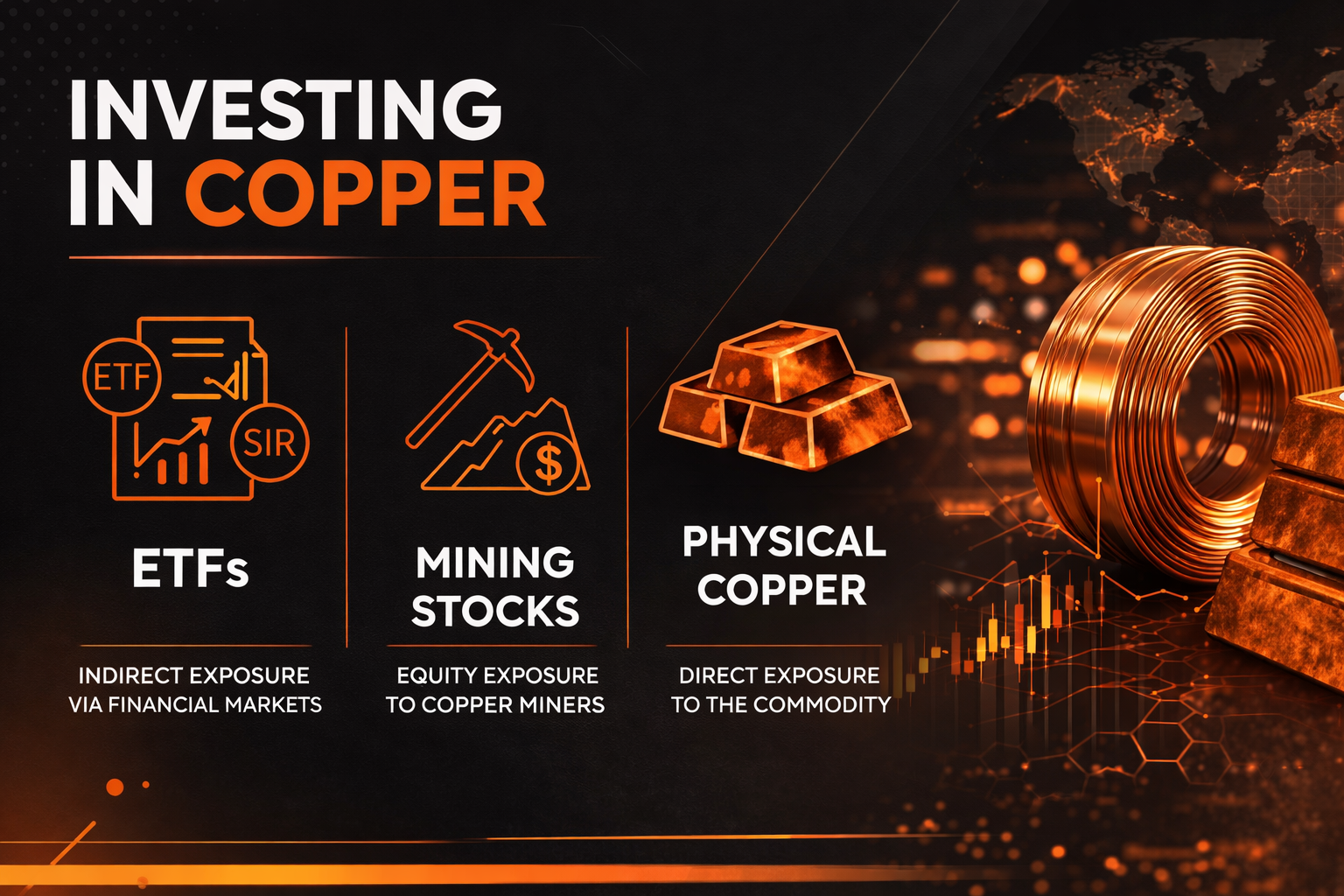
There are three main ways to invest in copper: ETFs, mining stocks, and physical copper, each offering different levels of exposure and risk. While ETFs and stocks provide indirect access through financial markets, physical copper offers direct exposure to the underlying commodity and its supply-demand dynamics. As demand for copper continues to rise globally, investors are increasingly exploring how to access the market more effectively.
Physical Copper Investment in 2026: Why Investors Are Looking Beyond Stocks and ETFs
Three ways to get copper exposure. Only one means you actually own copper.
Why Investors Are Revisiting Copper in 2026
Most people searching for copper exposure in 2026 never stop to ask the more important question: what exactly are they buying? As financial markets remain volatile in early 2026, investors are reassessing how they gain exposure to essential commodities. With equities fluctuating, cryptocurrency markets reacting sharply to liquidity conditions, and precious metals trading defensively, many are returning to the fundamentals of physical commodity ownership.
Copper is not just another commodity. It is one of the most strategically important industrial metals in the global economy. And as more investors ask how to access it, three distinct options typically come up: mining stocks, copper ETFs, and physical copper ownership. Each is structurally different. Each carries different risks. And only one of them means you own real metal.
This article covers the current copper market outlook and structural demand drivers, explains why investors are comparing copper ETFs, mining stocks, and physical ownership, sets out the structural differences between financial exposure and allocated metal, and shows how individual investors can access direct physical copper ownership today.
Copper Market Outlook 2026: Structural Demand Remains Strong
The copper market in 2026 is shaped by long-term electrification trends and infrastructure expansion. Demand is driven by power grid modernisation, renewable energy infrastructure, electric vehicle (EV) production, AI-driven data centre expansion, and industrial manufacturing growth across emerging economies.
According to the International Energy Agency (IEA, 2024), global copper demand is projected to nearly double by 2035 as countries accelerate energy transition initiatives. Current annual demand sits at approximately 26 million tonnes against mine supply of around 22 million tonnes: a structural deficit that is widening year over year. While short-term price fluctuations occur due to macroeconomic factors and seasonal inventory movements, the underlying supply-demand case remains intact.
The supply side offers little relief. New mines require 15 to 20 years to develop from discovery to production (S&P Global). Permitting timelines are increasing globally. Average ore grades have declined approximately 25% over the past two decades (USGS), raising the cost per tonne. Capital intensity across the sector remains high, and major producing nations including Chile and Peru face growing challenges around water access and social licensing.
"The imbalance between long-term demand growth and slow supply response underpins the structural copper case in 2026."
C4CU, February 2026
Copper ETFs vs Mining Stocks vs Physical Copper: Understanding the Difference
When investors search for how to add copper to a portfolio, they typically encounter three options. Each carries a structurally different risk profile and a different answer to the question: what do you actually own?
| Option | What You Own | Key Risk Factors | Physical Metal? |
|---|---|---|---|
| Mining stocks | Equity in a mining company | Management performance, operational disruption, equity sentiment, political risk | No |
| Copper ETF | Units in a fund tracking copper price | Roll costs, contango, fund structure, liquidity cycles | No |
| Physical copper | Allocated copper inventory registered in your name | Copper price volatility, storage costs, lower liquidity vs listed instruments | Yes |
Copper Mining Stocks
Mining equities provide indirect exposure to copper prices, but they are also shaped by corporate management performance, production costs, operational efficiency, political and regulatory risk, and broader equity market volatility. Mining stocks frequently move with equity sentiment rather than purely tracking copper fundamentals. A strike at a major mine, rising energy costs, or a risk-off market selloff can push a mining stock lower even when underlying copper supply-demand dynamics are strong.
Copper ETFs
Copper ETFs offer price tracking through futures or derivative structures. While they provide liquidity and accessibility, they remain financial instruments subject to roll costs (ETF tracking error from contango can be 5 to 15% per year), broader financial market volatility, and liquidity cycles. Most copper ETFs hold futures contracts, not physical copper. You own units in a fund. You do not own metal.
Why Physical Copper Ownership Is Structurally Different
Physical copper ownership provides direct exposure to the underlying industrial metal. Unlike stocks or ETFs, allocated physical copper does not rely on corporate earnings, does not depend on derivative roll structures, is not influenced by equity market sentiment, and represents tangible industrial material stored in a real, insured facility.
The distinction matters most in volatile market environments. When financial systems come under pressure, the gap between a paper claim on a commodity and actual allocated ownership becomes clearer. The 2022 LME nickel crisis illustrated this dynamic: when paper claims significantly exceed physical supply, the two can diverge sharply.
Allocated ownership means specific, identified physical metal is registered in your name at a storage facility. Your inventory is not pooled, not lent out, and not subject to fund-level counterparty risk. This is structurally different from holding ETF units or unallocated commodity accounts.
Copper is embedded in electrification and infrastructure: EV motors, power grids, renewable energy systems, and AI data centres all require it as an engineering input. Physical ownership aligns with that industrial reality in a way that financial instruments do not.
"In a market environment defined by uncertainty, the question is not just what to hold. It is what you are actually holding."
C4CU, February 2026
How to Own Physical Copper in 2026
Historically, owning physical copper has been impractical for individual investors due to high industrial minimum purchase sizes, storage complexity, and logistics and insurance challenges. These barriers were designed for institutional and industrial buyers, not retail participants.
C4CU was established to address exactly these barriers. Through the platform, individuals can access physical copper ownership starting from 10 kilograms, significantly below traditional industrial market minimums. The platform provides:
- Direct ownership of allocated LME Grade A copper cathodes
- Professional storage at an insured, bonded facility
- Transparent allocation with your name on the inventory
- One all-inclusive fee of 5%: no hidden charges, no fund structure between you and the metal
This structure allows individuals to hold copper as a physical industrial asset rather than through equity or derivative instruments. C4CU facilitates principal-to-principal transactions: you buy real metal and it is registered to you.
Physical copper does not generate yield. It is not a liquid instrument compared to listed ETFs or equities. Its price is volatile and can fall significantly. Copper has historically moved 30 to 50% within a single year. C4CU facilitates ownership, not advice. Review the full ownership structure before making any decision.
Key Considerations for 2026
Individuals evaluating copper strategies should consider their tolerance for commodity price volatility, whether they prefer price exposure through financial instruments or direct physical ownership, their time horizon relative to the copper demand cycle, and the structural demand drivers underpinning electrification and global infrastructure programmes.
No asset class is immune to volatility. But copper's role in the real economy, from power grids to EV motors to data centre wiring, is not speculative. A single EV requires approximately 83 kg of copper compared to 23 kg in a conventional vehicle (IEA, 2024). A hyperscale data centre can require between 20,000 and 40,000 tonnes of copper. These are engineering requirements underpinning trillions of dollars of committed infrastructure spend globally.
The question for 2026 is not simply whether copper belongs in a portfolio. It is which form of copper exposure actually reflects the underlying industrial reality.
Frequently Asked Questions
Q: Is physical copper a good investment in 2026?
The structural demand case for copper in 2026 is backed by the IEA's projection that global copper demand will nearly double by 2035, driven by EV manufacturing, grid electrification, and AI data centre build-out. Supply response is constrained: new mines take 15 to 20 years to develop (S&P Global) and average ore grades have declined approximately 25% over two decades (USGS). Whether physical copper belongs in a specific portfolio depends on individual risk tolerance and time horizon. It is not a yield-generating asset, its price is volatile, and it can go down as well as up.
Q: What is the difference between a copper ETF and owning physical copper?
A copper ETF typically holds futures contracts that track the copper price. You own units in a fund, not metal. Physical copper ownership means specific, allocated inventory is registered in your name at a storage facility. The two track a similar price but have different counterparty structures and cost bases. ETF tracking error from contango and roll costs can reach 5 to 15% per year. Allocated physical copper carries no fund-level counterparty risk, but is less liquid than an exchange-traded instrument and generates no yield.
Q: Why do copper mining stocks not simply track the copper price?
Mining equities are corporate stocks first. They reflect management decisions, production costs, operational disruptions, balance sheet strength, and broader equity market sentiment: all of which can diverge significantly from the underlying copper price. A mine strike, rising energy costs, or a risk-off equity selloff can push a mining stock lower even when copper supply-demand fundamentals are strong. For investors seeking pure copper exposure, mining stocks introduce additional variables that may not reflect the copper market itself.
Q: What are the risks of owning physical copper?
Key risks include commodity price volatility (copper has historically moved 30 to 50% within a single year), lower liquidity compared to listed instruments such as ETFs or equities, and ongoing storage and insurance costs. Physical copper generates no yield or dividend. It is a commodity with no maturity date. The price of copper can go down as well as up, and past performance is not an indicator of future results.
Q: What is driving copper demand in 2026?
Three structural forces dominate. First, transport electrification: a single EV requires approximately 83 kg of copper versus 23 kg in a conventional vehicle (IEA, 2024). Second, grid modernisation and renewable energy infrastructure, where a solar farm uses five times more copper per MW than a gas plant and an offshore wind turbine uses 8 to 15 tonnes of copper. Third, AI data centre expansion: a hyperscale facility can require 20,000 to 40,000 tonnes of copper. These are capital infrastructure commitments spanning years, not speculative cycles.
Q: How do I own physical copper in the UK without storing it myself?
C4CU (Cooper 4 Copper, operated by A42C Ltd) provides access to LME Grade A copper cathodes from 10 kg, with allocated ownership registered in your name, professional storage at an insured bonded facility, and a single all-inclusive fee of 5%. There are no hidden charges and no fund structure between you and the metal. The platform facilitates principal-to-principal transactions: you own the copper directly. C4CU is not a financial advisor or broker and does not offer investment advice.
Ready to Own Physical Copper?
Start with as little as 10 kg of LME Grade A copper cathode: stored, insured, and allocated in your name. One fee. No hidden charges. No fund structure between you and the metal.
Start Owning Copper →
Get Copper Market Updates
Join investors receiving insights on copper prices, market trends, and opportunities. Free, no spam.
By subscribing, you agree to our Privacy Policy.
Ready to Own Real Copper?
Start owning physical copper today. Simple, transparent, accessible.