


Copper vs Gold: Which Is the Better Inflation Hedge?
Gold has traditionally served as a hedge against inflation and currency devaluation, driven largely by financial markets and investor sentiment. Copper, however, is supported by real industrial demand from electrification, infrastructure, and global economic growth, with supply constraints creating long-term pressure. While gold protects wealth during uncertainty, copper increasingly reflects structural growth, making both metals relevant in different economic conditions.
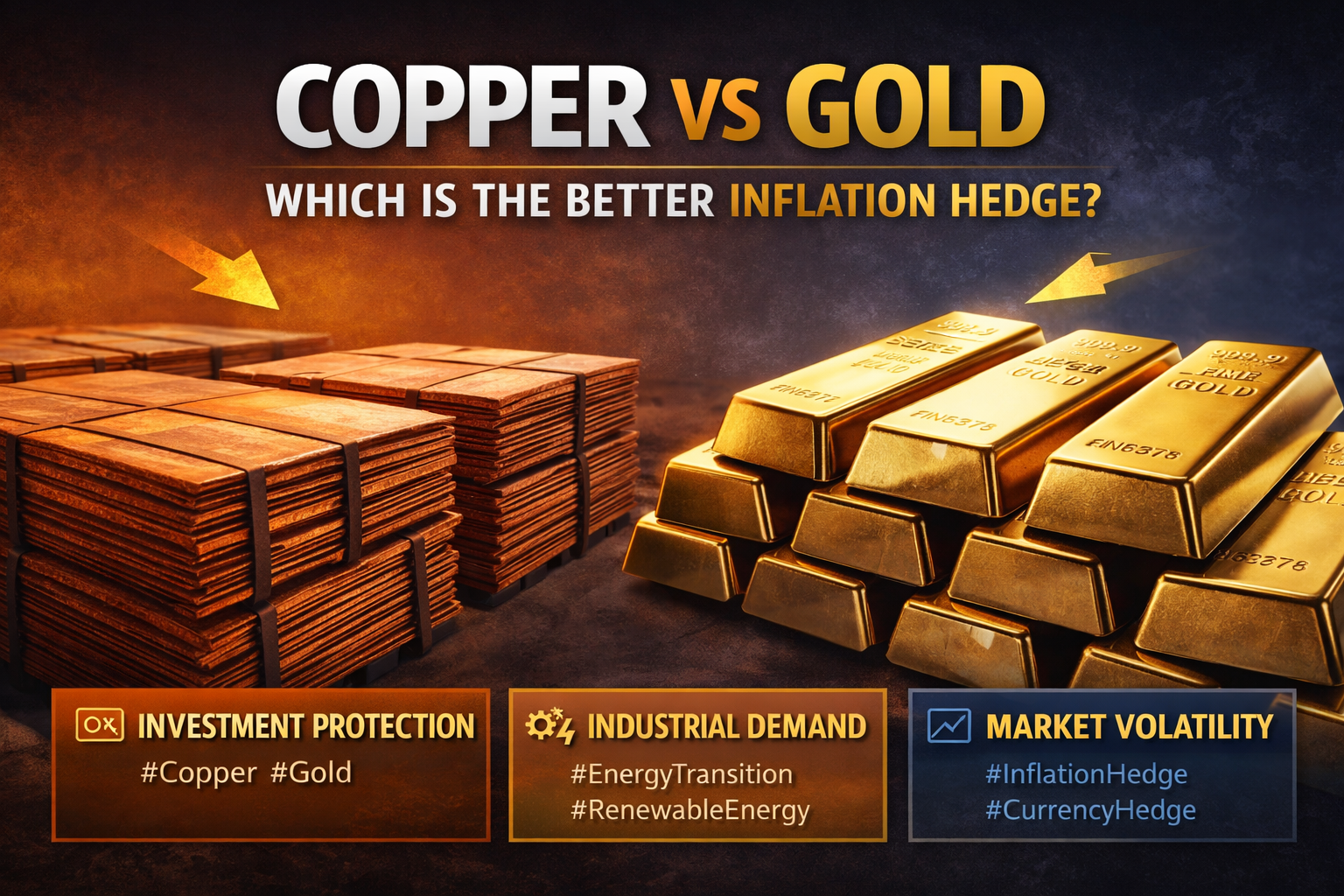
Copper vs Gold: Which Is the Better Inflation Hedge?
Gold has centuries of history as a store of value. Copper has the structural demand of the 21st century. The comparison is more interesting than most investors realise.
A Comparison Worth Having
Gold's reputation as an inflation hedge is decades old. Central banks hold it. Portfolios default to it. The logic is simple: when currencies weaken, gold holds its ground. But a quieter case is building for copper, and it rests on something gold has never claimed: the world actually needs it. Not for jewellery or reserves. For electric vehicles, power grids, data centres, and the infrastructure of the energy transition.
This article breaks down how each metal behaves under inflationary conditions, what drives their prices, and why the better hedge depends on which economic forces you expect to dominate.
How Gold Works as an Inflation Hedge
Gold functions primarily as a financial hedge. Its price responds to monetary policy, interest rates, USD strength, and investor sentiment rather than to physical consumption. When real interest rates fall, when central banks print money, or when confidence in fiat currency erodes, gold typically rises. That's the mechanism.
Central banks globally hold over 35,000 tonnes of gold as part of their foreign reserves (World Gold Council, 2024). That institutional bedrock gives gold a floor that pure commodities don't enjoy. Gold performs best when markets face uncertainty, when interest rates are declining, and when investors are prioritising capital preservation over growth.
The limitation: gold's price is heavily sentiment-driven. It doesn't need to be used. It just needs to be believed in. That's a strength in a crisis. It's a weakness in a growth cycle.
"Gold protects wealth. Copper reflects growth. In an era defined by industrial transformation, that distinction matters more than ever."
C4Cu Research Team, 2026
How Copper Works as an Inflation Hedge
Copper operates differently. It is an industrial metal: its price tracks real economic activity rather than financial sentiment. When infrastructure spending rises, when electrification accelerates, when factories expand, copper demand rises with them. That demand-pull relationship is what makes copper a credible inflation hedge in an economy driven by physical output and capital expenditure.
The structural numbers are significant. Global copper demand is projected to double by 2035 (IEA, 2024), while current mine supply sits at roughly 22 million tonnes against demand of 26 million tonnes per year. A single electric vehicle uses approximately 83 kg of copper, compared to 23 kg in a conventional car. One AI data centre requires as much copper as 30,000 homes (C4Cu research, sourced from industry estimates [VERIFY latest figures]). Offshore wind turbines use 8 to 15 tonnes of copper each.
This is not sentiment. This is physics and engineering. The energy transition cannot happen without copper, and the gap between what mines produce and what the world needs is widening.
Gold hedges against financial instability: currency debasement, falling real rates, collapsing confidence. Copper hedges against industrial inflation: rising input costs, infrastructure expansion, supply scarcity. The better hedge depends on which type of inflation is driving the environment you are in.
Side by Side: Four Key Differences
The two metals behave differently across every dimension that matters to a long-term holder. Here is how they compare:
| Factor | Gold | Copper |
|---|---|---|
| Demand Drivers | Financial markets, central bank accumulation, inflation expectations, investor sentiment | Industrial activity, electrification, EVs, renewables, data centres, infrastructure |
| Price Behaviour | Rises during uncertainty; sensitive to interest rates and macro sentiment | Moves with economic growth; builds through structural demand; less short-term reactive |
| Supply Constraints | Finite but mined consistently; recycling adds significant secondary supply | New mines take 15 to 20 years to develop; ore grades declining; major deposits aging |
| Role in Weak-Currency Economies | Traditional safe haven; widely held in countries facing currency instability | LME-priced globally; independent of local currency fluctuations; growing relevance for emerging markets |
The Supply Constraint Case for Copper
One of the strongest arguments for copper as a long-term store of value is the structural imbalance between supply and demand. New copper mines take 15 to 20 years to develop from discovery to production. Average ore grades have fallen roughly 25% over the last 20 years (S&P Global, 2023), meaning more rock must be processed to produce the same amount of copper. Chile and Peru, which together account for approximately 40% of global supply, face compounding challenges including water scarcity, aging infrastructure, and growing community opposition to new projects.
Meanwhile, demand is accelerating. The IEA projects a structural copper deficit will widen through the 2030s as electrification outpaces mine development. This is not a cyclical imbalance. It is a structural one. When supply cannot grow fast enough to meet demand, price pressure is the result, and that is a different kind of inflation protection than gold offers.
Currency Instability: Where Gold Still Leads
For individuals in countries experiencing acute currency devaluation, gold remains the more established hedge. In markets like Argentina, Turkey, Nigeria, and others where local currencies have lost significant purchasing power, gold's long history as a monetary asset and its deep retail liquidity make it the default choice for wealth preservation.
That said, copper's case in these markets is growing. Because copper is priced via the London Metal Exchange in US dollars, holding physical copper provides exposure to a globally-priced commodity that is independent of local currency dynamics. The growing accessibility of physical copper ownership through platforms that hold LME Grade A cathodes in allocated storage means this option is no longer limited to institutions.
Physical Ownership vs Financial Exposure
There is an important distinction between owning a metal and owning a financial product linked to its price. Gold has a well-established retail market for physical bullion: coins, bars, and allocated accounts are accessible to most individual buyers. Physical copper has historically been different. The LME trades copper in 25-tonne lots, designed for industrial buyers, not retail portfolios.
That structural gap has been closing. Platforms now exist that allow individuals to own allocated physical copper cathodes at much smaller sizes, with professional storage and insurance in place. For those comparing the two metals as real-world stores of value rather than paper positions, that shift in accessibility changes the calculation.
Most copper ETFs do not hold physical copper. They hold futures contracts, which are subject to roll costs and contango effects that can erode returns by 5 to 15% annually (C4Cu analysis, based on LME data). Physical ownership eliminates that tracking error and removes counterparty risk from the equation.
Which Metal Wins? It Depends on Your Thesis
The honest answer is that "better" depends on what you are hedging against and over what time horizon. Gold performs best in environments of financial stress: falling interest rates, currency debasement, and collapsing institutional confidence. Copper performs best when the economy is building: rising infrastructure spending, accelerating electrification, and structural supply shortfalls.
Given the scale of the energy transition, the AI infrastructure buildout, and the widening gap between copper supply and demand, a compelling case exists that we are moving into precisely the kind of macroeconomic environment where copper's structural fundamentals assert themselves over gold's sentiment-driven premium. That is not a prediction. It is a reading of the structural forces already in motion.
Both metals have a place. The question is which deserves more weight given the decade ahead.
Frequently Asked Questions
Q: Is copper a better inflation hedge than gold?
It depends on the type of inflation. Gold hedges against monetary inflation: currency debasement, falling real rates, and collapsing financial confidence. Copper hedges against industrial inflation driven by rising infrastructure spending, supply scarcity, and structural demand growth. The IEA projects global copper demand to double by 2035 while mine supply is already running roughly 4 million tonnes short of annual demand. In an energy-transition economy, copper's structural case is growing.
Q: Why is gold considered a safe haven asset?
Gold is not tied to any specific economy, government, or industrial supply chain. Central banks globally hold over 35,000 tonnes of it as a foreign reserve asset (World Gold Council, 2024). Its price historically rises during periods of financial instability, interest rate declines, and currency devaluation because it functions as a monetary asset rather than an industrial input. That independence from economic output is its defining characteristic as a safe haven.
Q: What is driving the increase in copper demand?
Four primary forces: electric vehicles (each using approximately 83 kg of copper versus 23 kg in a conventional car), renewable energy infrastructure (a solar farm uses 5 times more copper per megawatt than a gas plant), AI and data centre buildout (a single AI data centre requires as much copper as 30,000 homes), and grid expansion required to connect all of the above. These are structural shifts, not cyclical demand spikes.
Q: What is causing the copper supply shortage?
Three compounding factors: long development timelines (new mines take 15 to 20 years from discovery to production), declining ore grades (average grades have fallen roughly 25% over 20 years, meaning more material must be processed for the same output, per S&P Global 2023), and geographic concentration risk (Chile and Peru together supply around 40% of global copper, and both face water scarcity and social licence challenges). The result is a supply pipeline that cannot respond quickly to rising demand.
Q: Can copper hedge against currency devaluation?
Yes, with an important caveat. Because copper is priced globally on exchanges like the London Metal Exchange in US dollars, physical copper ownership provides exposure to a hard asset that is independent of local currency performance. For holders in markets experiencing high inflation or currency instability, this global pricing mechanism provides a similar isolation from local monetary policy that gold offers. The key word is physical: paper copper products tied to local markets do not carry the same benefit.
Q: Is physical copper liquid enough to sell when I need to?
Physical copper held as LME Grade A cathodes trades against a globally liquid benchmark. The LME handles approximately $15 trillion in metals trading per year, providing a transparent reference price. That said, physical copper is not as immediately liquid as gold coins or listed ETFs. It is best understood as a medium to long-term holding rather than a short-term trading instrument. Sellers of allocated physical copper typically need to account for logistics and settlement timelines, which can range from days to a few weeks depending on the platform and buyer.
Q: How can individuals own physical copper without storing it themselves?
Physical copper was historically accessible only to industrial buyers and institutions because LME contracts trade in 25-tonne lots. Platforms like Cooper 4 Copper (C4Cu) now enable individual buyers to own allocated LME Grade A copper cathodes starting from 10 kg, with the physical metal held in a professional storage facility, insured, and registered in the buyer's name. The buyer does not need to arrange logistics or storage, but the copper is genuinely theirs, not a paper promise.
Ready to Own Physical Copper?
Start with as little as 10 kg of LME Grade A copper cathode, stored, insured, and allocated in your name.
Start Owning Copper →
Get Copper Market Updates
Join investors receiving insights on copper prices, market trends, and opportunities. Free, no spam.
By subscribing, you agree to our Privacy Policy.
Ready to Own Real Copper?
Start owning physical copper today. Simple, transparent, accessible.